Articles · Choosing an agency
Top 10 Shopify agencies
Published
We are one of the ten agencies on this page and we have put ourselves first, so read it knowing both of those things. The order is not a quality ranking, it is a fit ranking, and it is ranked for one specific reader: a UK or US brand that wants the senior people who sold the work to be the people who do it. Rank for a different reader and this list reorders. Every agency here also carries a plain statement of what it does better than we do, because a list without that is an advert.
These are ten UK agencies. Four of them keep New York offices and most work with US brands, which is why the list is worth your time from either side of the Atlantic. If you specifically want a US-headquartered agency, this is not that list.
How this list was put together, and its limits
The starting pool came from a competitor’s published Shopify agency list. That is a legitimate place to start, because those are the agencies currently associated with the category, but it is only a starting point: every agency below was then read from its own website on 7 August 2026, and what appears here is what each one says about itself on that date, not our characterisation of it and not a competitor’s.
Being explicit about why that step matters: the list we drew the pool from carries claims about a named agency’s location and founding year that the agency’s own site contradicts. Copying that research would have meant republishing someone else’s errors under our name.
The order is by fit for the reader described at the top, not by revenue, headcount or awards. Concretely, it ranks one thing: how directly you are likely to work with senior people, which we have judged from each agency’s own stated scale and structure. That is a rough proxy and worth treating as one. It favours senior, founder-led teams, so the largest and most process-heavy agencies here sit lower down. That is a consequence of the criterion rather than a judgement on their work, and several of them would be the better call if your brief is a fifty-person bench and formal process rather than direct access to seniors. Where that is true, their entry says so.
Three honest limits. We have not audited anyone’s work or spoken to their clients, so nothing here is an assessment of what any of these agencies actually deliver. One agency in the original pool, Statement, is absent because it no longer operates an independent website. Its domain now redirects to the agency group that acquired it in 2018, and that group’s current site does not mention the Statement name at all. And we have not independently confirmed who currently ranks for these terms in Google, in either the UK or the US; this list reflects published reputation and verified facts, not measured search performance.
The ten
The short version first. Each name jumps to its full entry, which is where the part that matters sits: what that agency does better than we do.
| Agency | Based | Stated tier | Best for |
|---|---|---|---|
| 1. Elms Agency | London, working across the US and the UK | Plus Partner | Direct access to the senior people |
| 2. Underwaterpistol | London | Plus Partner | Distinctive, design-led builds |
| 3. Heseven | London, New York, Melbourne and Mumbai | Not stated | A global team across four time zones |
| 4. Fourmeta | London | Not stated | Buyers who weigh awards and directories |
| 5. Blubolt | London and Bath | Platinum Partner | A long ecommerce trading history |
| 6. Propeller | London and New York | Not stated | Build and growth marketing together |
| 7. By Association Only | London | Platinum Partner | Luxury and premium brands |
| 8. We Make Websites | London and New York | Plus Partner | Established, multi-market brands |
| 9. Swanky | UK, Australia and France | Platinum Partner | Teams split across regions |
| 10. Charle | London, Manchester and New York | Plus Partner | Build and organic growth, one team |
-
Elms Agency
London, working across the US and the UK Shopify Plus Partner
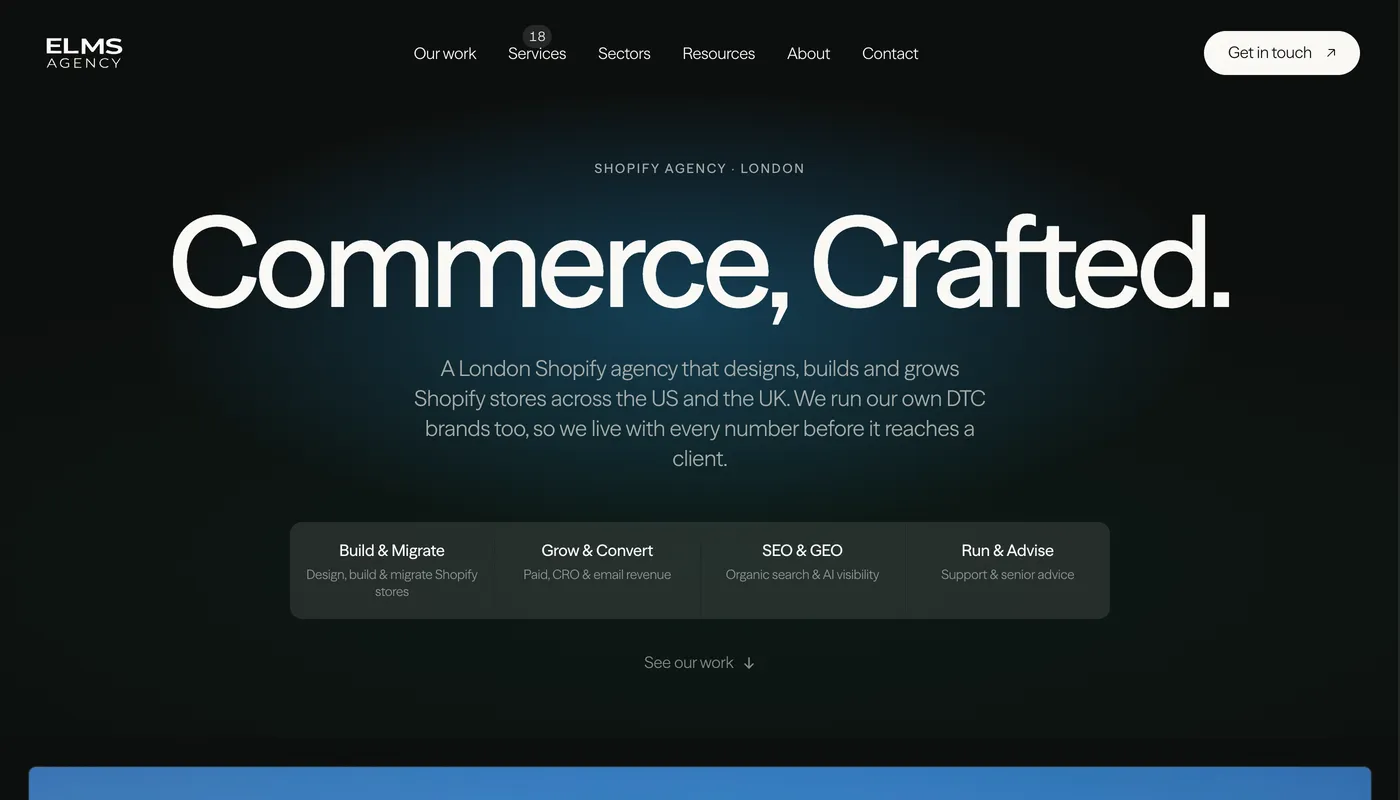
In their own words. Founder-led, 100+ builds since 2018, and we run our own DTC brands on Shopify with our own money.
Who it suits. Brands who want the senior people who sold the work to be the ones doing it, and who want performance claims they can re-run themselves.
Where they beat us. Published third-party awards, and the specialist bench depth that comes with a larger team, where several agencies here have more behind them than we do. What we offer instead is that our own stores are public and our own site’s Core Web Vitals can be re-run by anyone, so you can check the claims before you speak to us.
What we do. Shopify web design , Shopify development , Shopify Plus , theme development , app development , integrations , migrations , ecommerce SEO , conversion rate optimisation , maintenance and support . The full list is on our services, and the work itself is on our portfolio.
-
Underwaterpistol
London Shopify Plus Partner
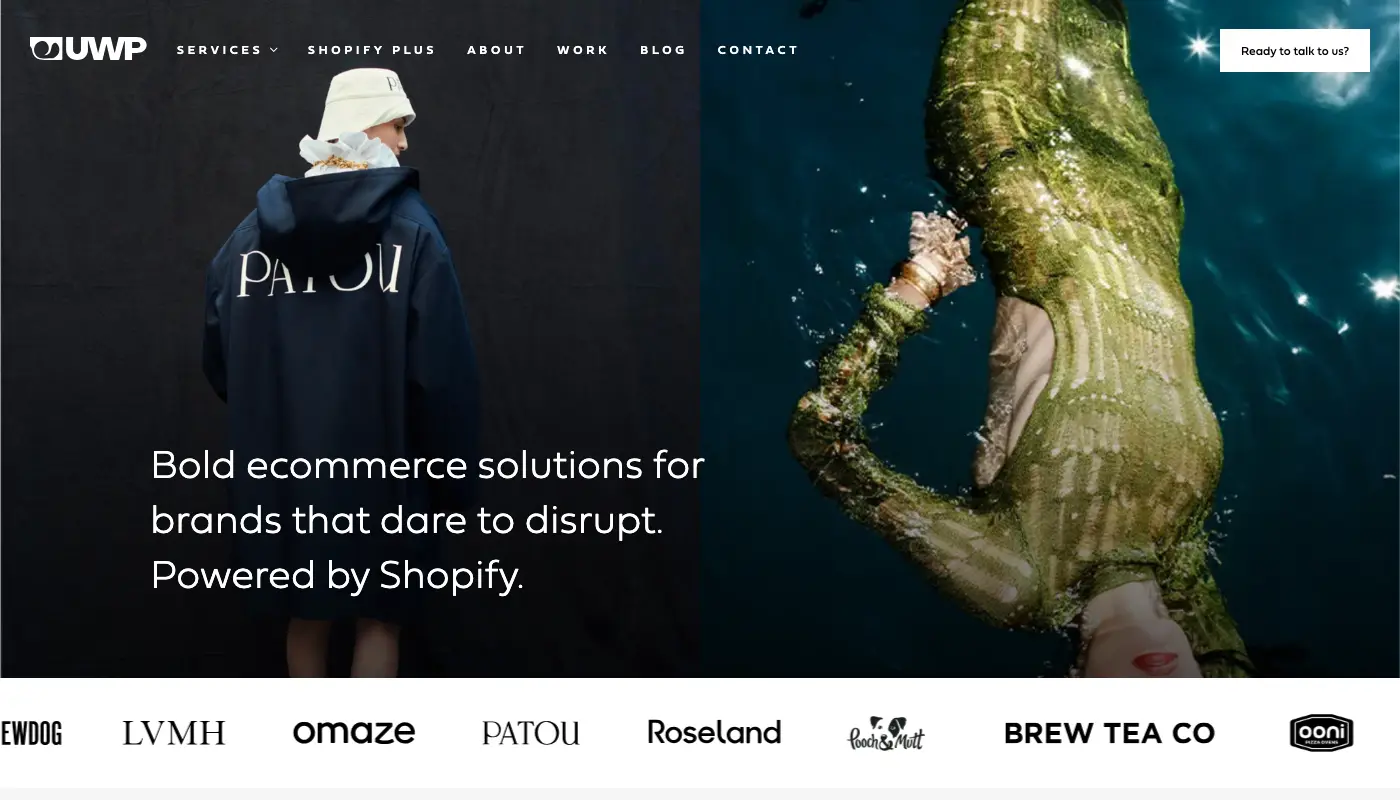
In their own words. A Shopify Plus Partner describing itself as building "bold ecommerce solutions for brands that dare to disrupt," stating over 20 years designing, building and optimising ecommerce stores, with named work for Ooni and Reach PLC.
Who it suits. Brands wanting a distinctive, design-led build over a templated one, backed by a long ecommerce track record.
Where they beat us. Two decades of ecommerce-specific experience predating Shopify itself, which shows in how confidently they talk about disruption rather than safety.
-
Heseven
London, New York, Melbourne and Mumbai
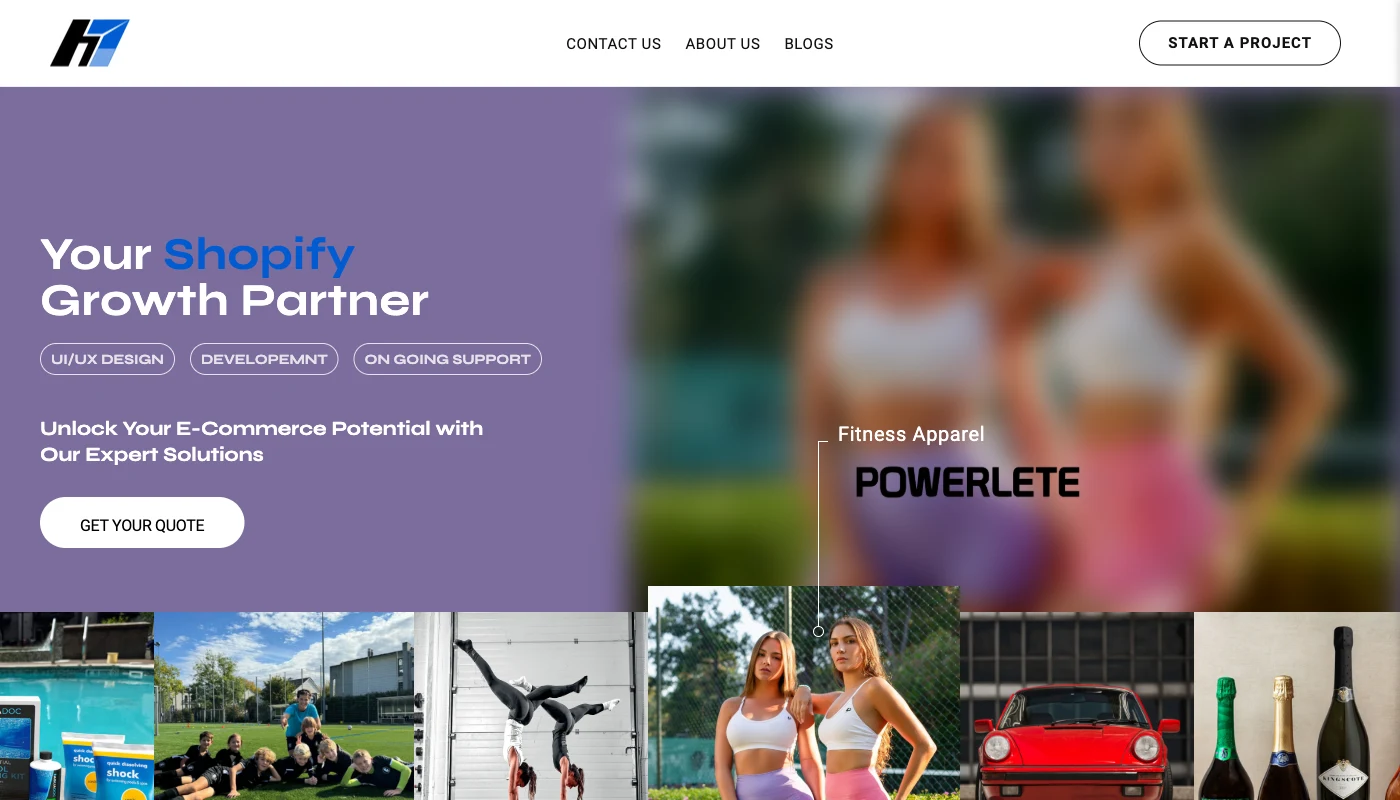
In their own words. Describes itself as "a leading Shopify Expert agency, delivering top-notch services globally since 2018," offering store builds, migration, CRO, speed optimisation, SEO, maintenance and white-label development. States it is "trusted by 1000+ eCommerce brands" across sectors including fitness apparel, beauty and drinks. Does not state a formal Shopify partner tier on its site.
Who it suits. Brands wanting a global, always-on team across four time zones, or an agency comfortable working white-label alongside another.
Where they beat us. Footprint. Four offices across three continents covers hours we cannot staff from London alone, and a stated 1000+ client base is real breadth on the platform.
-
Fourmeta
London
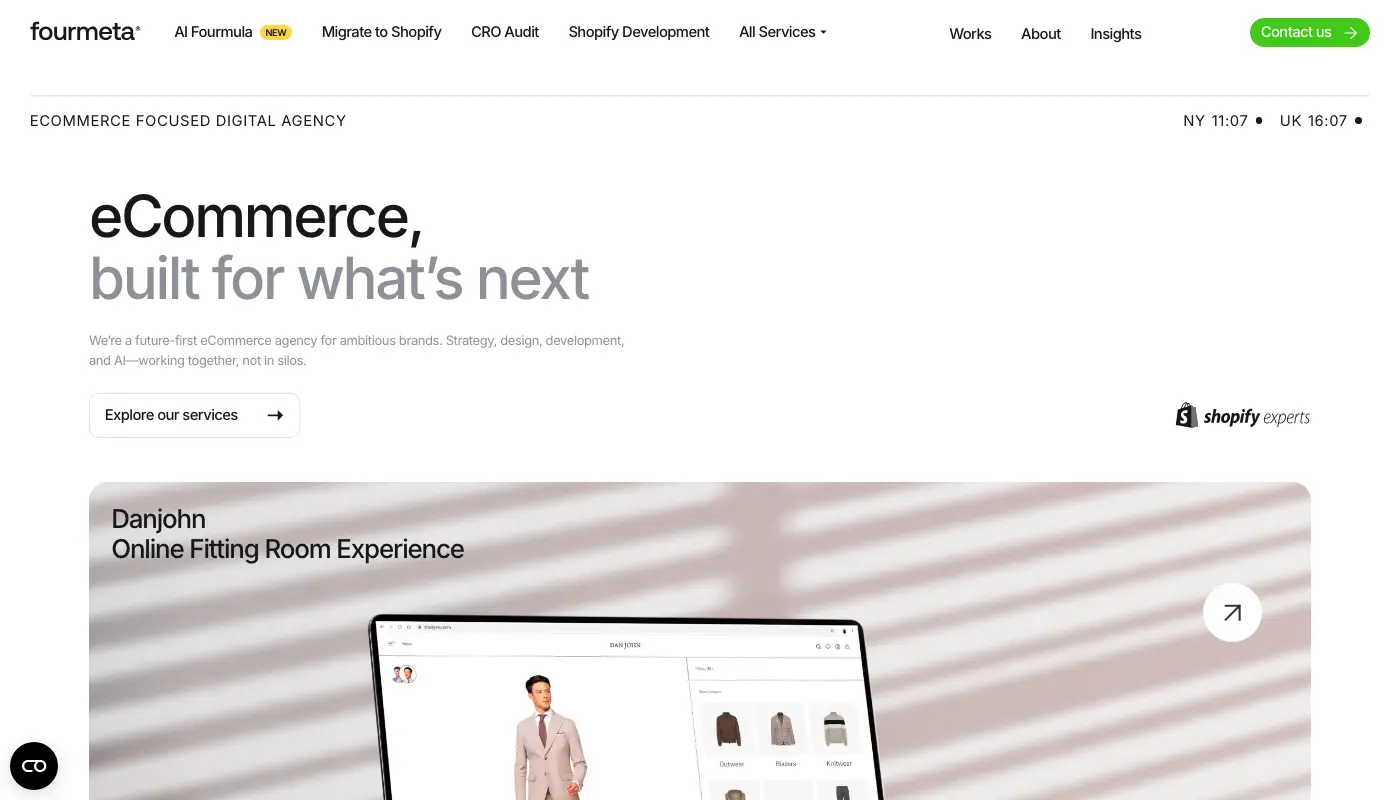
In their own words. Describes itself as a "full-service Shopify development company" since 2012, and is Clutch-ranked "Top Shopify Company UK" for 2023. Does not state a formal Shopify partner tier on its site.
Who it suits. Brands who weigh third-party award and directory recognition (Clutch, Awwwards) alongside an agency’s own claims.
Where they beat us. External validation. A Clutch category win and an Awwwards mention are independent signals we do not currently hold.
-
Blubolt
London and Bath Shopify Platinum Partner
In their own words. A Shopify Platinum Partner, founded 2006, structuring its work into launch, migration and growth stages, with published conversion-uplift figures for named clients including Newby Teas.
Who it suits. Brands who value a long, continuous trading history in ecommerce over a newer specialist.
Where they beat us. Longevity. Trading since 2006 is a track record we do not have and cannot manufacture.
-
Propeller
London and New York
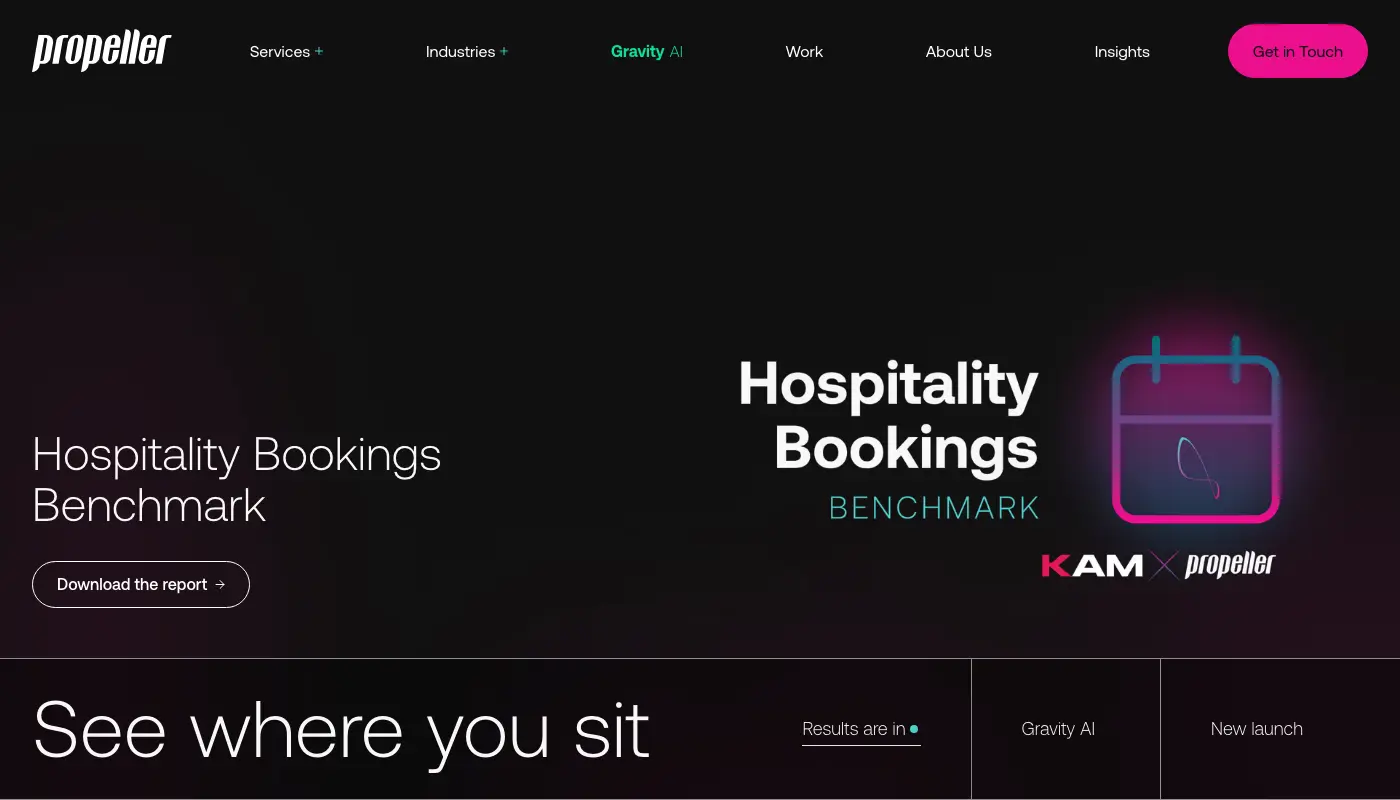
In their own words. Calls itself a "full service Shopify Agency partner" spanning design, development, migration, CRO and marketing, stating a 40-person multi-disciplinary team. Does not state a formal Shopify partner tier on its site.
Who it suits. Brands wanting build and growth marketing under one roof without needing the largest agency on this list.
Where they beat us. Team breadth. A stated 40 specialists covers channel marketing roles we do not staff in-house.
-
By Association Only
London Shopify Platinum Partner

In their own words. A Shopify Platinum Partner positioning itself as "the Platinum Shopify Plus agency for the world’s most design-conscious brands," naming 50-plus luxury clients including Victoria Beckham and Self-Portrait.
Who it suits. Premium and luxury brands where design execution is the whole brief, not a line item alongside it.
Where they beat us. A luxury-specific portfolio with named clients at that scale, including Victoria Beckham and Self-Portrait. If your brand sits in that bracket, their client list is the more relevant reference than ours.
-
We Make Websites
London and New York Shopify Plus Partner
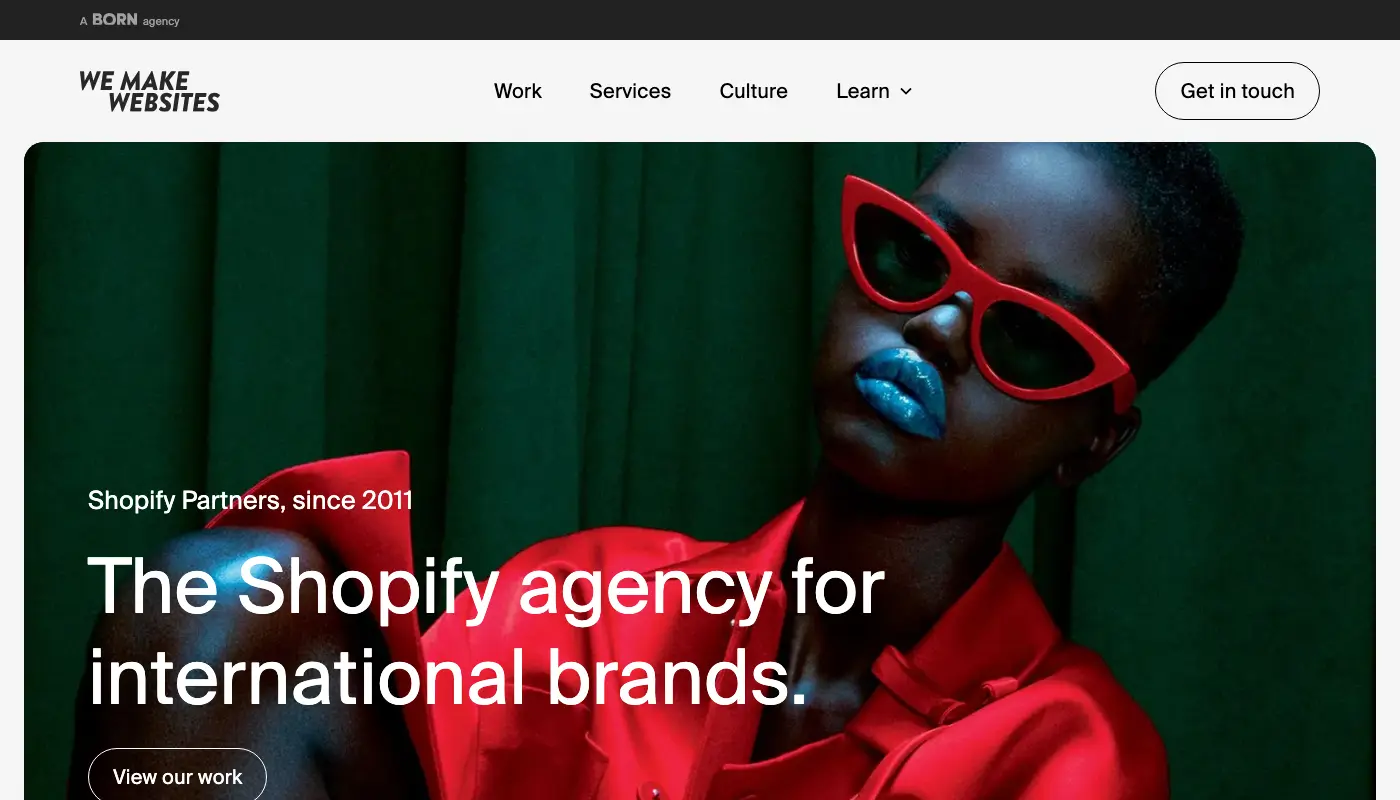
In their own words. A Shopify Plus Partner since 2011, describing itself as UX, strategy and development across internationalisation, data migration and headless commerce, and calling itself "a safe pair of hands in the Shopify world."
Who it suits. Established, multi-market brands who want an agency with the longest continuous Plus Partner history on this list.
Where they beat us. Tenure. A Plus Partner since 2011, predating our own founding, and their client list (Jigsaw, HP, Condé Nast) reflects that scale.
-
Swanky
UK, Australia and France Shopify Platinum Partner
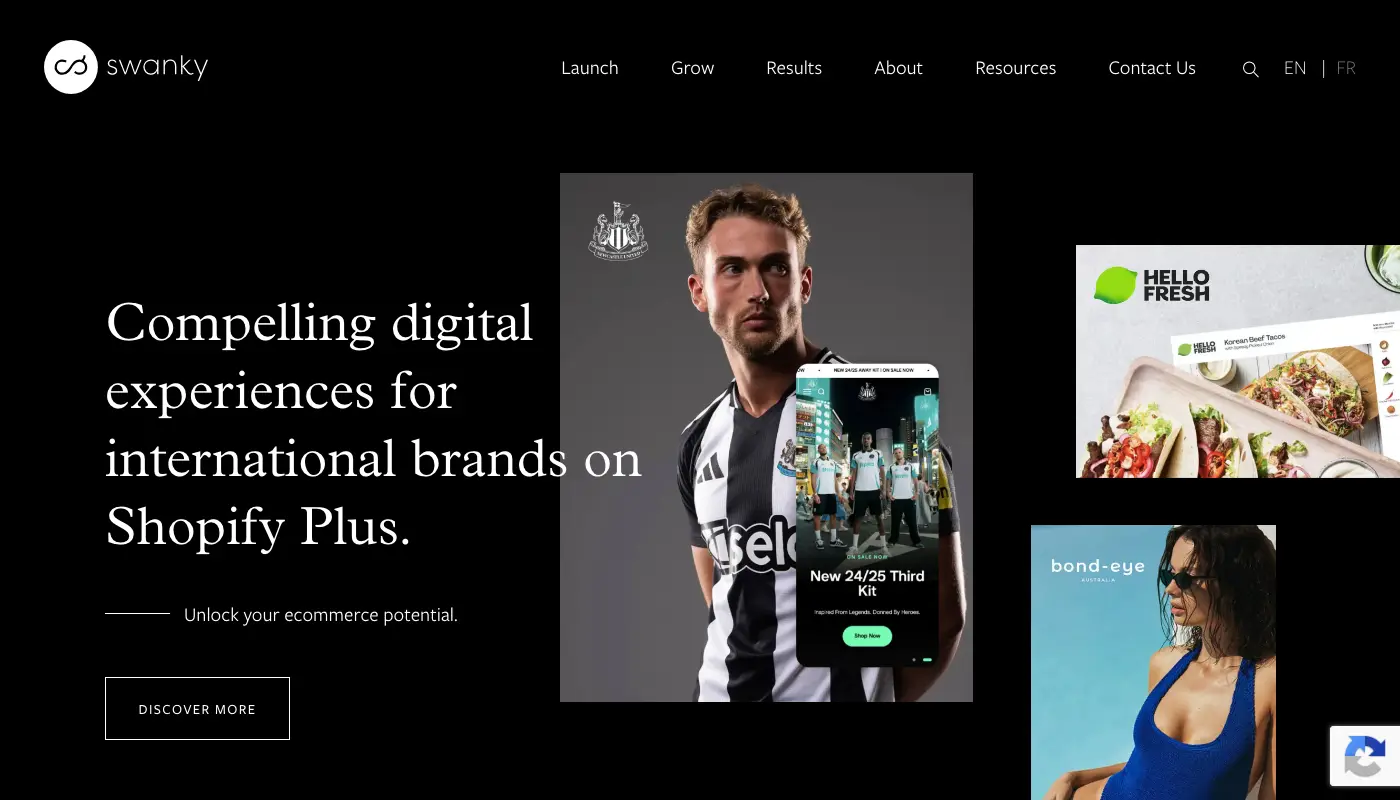
In their own words. A Shopify Platinum Partner describing itself as building and growing "exceptional Shopify stores for international brands," and stating around 15 years of client work with 20-plus published case studies.
Who it suits. Brands selling across several regions who want working hours in more than one of them.
Where they beat us. Timezone and territory coverage. Three offices across three countries is something we cannot match from London, and it matters if your team is split.
-
Charle
London, Manchester and New York Shopify Plus Partner
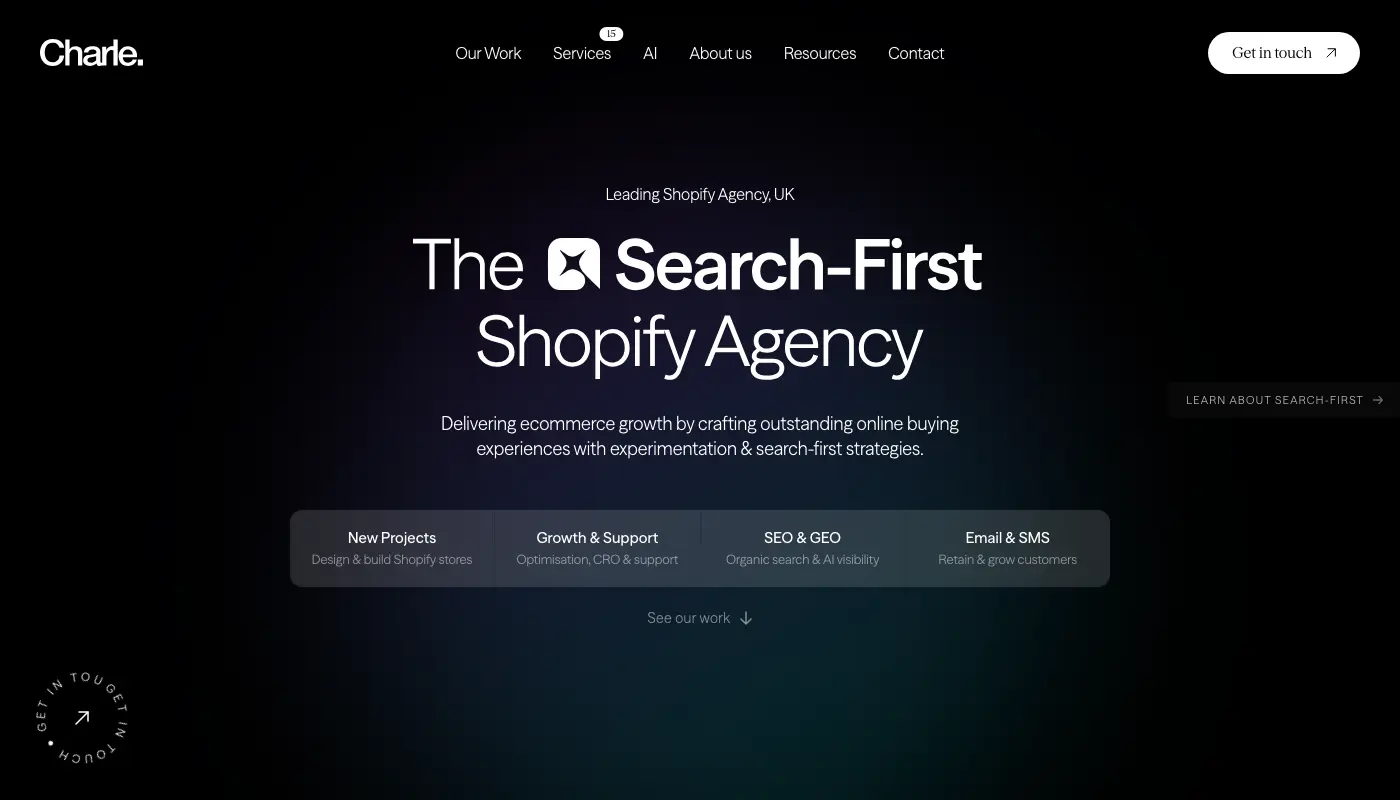
In their own words. A Shopify Plus Partner describing itself as designing, building, migrating and growing high-performance Shopify and Shopify Plus stores through "structured, search-first foundations and ongoing behavioural experimentation." States over £300m in revenue through its stores and a 44% average conversion uplift across its client base.
Who it suits. Brands who want build and organic growth run by the same team, backed by a large published body of ecommerce research.
Where they beat us. Authority and reach. Their published library and the links it has earned are years ahead of ours. They are also the most direct comparison on this list: same platform, same country, similar buyer.
What a Shopify agency is, and what one actually does
A Shopify agency is a company whose main business is building, growing or running stores on Shopify, rather than one that treats it as one platform among several. That distinction sounds like marketing and is not. A general web agency will happily build you a Shopify store; a Shopify agency has already made most of the mistakes the platform allows, and knows which of its limits are real and which have a workaround.
The work divides into three jobs, and most brands need one of them far more than the other two. Building covers theme development, custom functionality, integrations and replatforming from somewhere else. Growing covers search, conversion, paid media and email once the store is live. Running is the unglamorous monthly work of fixes, app conflicts and small changes that nobody sells hard because it does not demo well.
Beyond Shopify itself, most agencies at this level will also take on work the platform does not do natively: a custom app where no existing one fits the process, an integration with an ERP or a warehouse system, or a headless build where the storefront and the checkout are decoupled. That is the honest answer to whether a Shopify agency can handle bespoke software. Usually yes, and the better question is whether your problem genuinely needs it, because custom code is something you own and maintain for as long as the store exists.
What actually separates them
Less than the tier badges suggest. Every agency on this list can build a genuinely capable Shopify store, and most hold some level of Shopify’s own partner accreditation. The differences that matter show up after you have signed: who specifically does the work, what happens when something breaks outside working hours, and whether any performance claim in the pitch is one you can check yourself on a live URL rather than take from a case study.
We wrote a longer version of that in how to choose a Shopify agency, and a companion piece on boutique versus big agencies that argues the case for the larger firms on this page as fairly as we could manage.
If your build is specifically Shopify Plus at enterprise scale, see best Shopify agencies for Plus brands, a narrower and larger-scale list built for that brief.
Why hire a Shopify agency, and when not to
The honest case for an agency is cover and range, not raw skill. A good freelancer will out-build a mediocre agency on a bounded piece of work and charge less for it. What a freelancer cannot do is be in two places at once, or be ill in the middle of a migration.
So the real question is what the work spans. A theme customisation, a set of templates, a design refresh on a store that already functions: that is freelancer work, and agency rates buy you process you will not use. A migration carrying years of order history, a subscription flow, a B2B channel, an ERP integration, or selling into several markets at once: that spans disciplines, and the risk lands on a business rather than on a website. A good freelancer will tell you when a brief has outgrown them, and the tell that one has not is a quote that seems remarkably low for the scope described.
For a founder at the start it is a different calculation again. An agency earns its place early when your own time is worth more than the fee, or when a platform decision made badly in month one costs a rebuild in year two. It does not earn its place on a first store with no catalogue and no traffic, which is a good theme and a weekend. We argued the whole thing at length, including the case for the larger firms on this page, in boutique versus big agencies.
How to choose between them, and what to ask before you sign
Credentials narrow the field. They do not pick the winner. Every agency here can build a capable store and most hold some level of Shopify's own accreditation, so what separates them is how the relationship works after the contract is signed, which no badge reports on.
Four questions get further than any list of credentials. Who specifically will do the work, by name, and will those people be in the room while you are being sold to. What happens when something breaks outside working hours, and is that answer in writing rather than in a conversation. Can you check any performance claim yourself, on a live URL, rather than take it from a case study. And who owns the theme code and the accounts at the end, which should always be you.
Two more are worth asking if your build is at all unusual. Ask which of build, growth and support they actually staff in-house, and be careful with anyone claiming all three at depth without the headcount behind it. And ask what they would recommend for your order volume rather than which plan they sell, because those are not reliably the same answer. The longer version, with what a good answer to each sounds like, is in how to choose a Shopify agency.
What a Shopify agency costs, and how long a build takes
Both answers are ranges, and anyone quoting a firm number before seeing your catalogue, your integrations and your current platform is guessing. The number will move later, and it will not move down.
On cost, in the UK: a straightforward build on an existing theme typically runs into the low thousands. A custom build runs into the tens of thousands. An enterprise migration onto Shopify Plus runs well beyond that. Ongoing work is normally a monthly retainer rather than a project fee. What moves the figure is rarely the design. It is catalogue size, how many systems have to talk to each other, and how much of your existing data has to survive the move.
On time, a theme customisation can be a fortnight. A custom build is commonly two to four months. A migration depends far more on your data than your design, which catches people out: product variants, customer accounts, order history and redirects are where the weeks go, and a catalogue of several thousand SKUs with years of orders behind it is a different project from one with a hundred products. Ask for the timeline broken into discovery, build and launch rather than as a single figure. A quote that cannot be broken down is a quote nobody has thought about properly.
Migrating an existing store onto Shopify
Migration is among the most common briefs on this list and every agency here will take one on. Moves from Magento, WooCommerce, BigCommerce and bespoke platforms are routine work rather than specialist work.
What decides whether it goes well is unglamorous. Product data and variants have to map onto Shopify's own model, which is not always a one-to-one fit and is where scoping usually goes wrong. Customer accounts and order history have to survive, or your returns process breaks on day one. And the URL redirects have to be right, because the search visibility you already have is an asset you can lose in an afternoon and spend a year earning back.
Ask specifically about redirects. It is the step most often rushed, it is invisible on launch day, and by the time traffic drops the damage is already indexed. We keep SEO migrations as a separate service from the migration itself for exactly that reason: they are different jobs, and the second one is not free just because the first one happened.
Who owns the store, the code and the accounts afterwards
You should own all of it, and it is worth confirming in the contract rather than assuming.
Your Shopify account is always yours and no agency can take it. What gets vague is everything around it: the theme code, any custom apps built for you, and the accounts for analytics, email, payments and advertising. Those should all end up in your name, on your billing, with you as the owner rather than a user somebody else can remove. The test is simple. If you ended the relationship tomorrow, what would you still be able to log into.
Where this occasionally goes wrong is a proprietary theme or framework an agency licenses to you rather than hands over. That is not automatically a bad deal, and it sometimes buys something genuinely better than a stock theme. It is a deal worth understanding before you sign rather than discovering when you decide to move, because it turns a change of agency into a rebuild.
Shopify Plus partners, and what the tiers mean
Seven of the ten, ourselves included, describe themselves as Shopify Plus partners of one tier or another, and the tier language is the most misread thing in this market. There are three levels worth knowing. Partner is the open programme, and any agency can join it. Plus Partner is granted to agencies with a real track record on Plus. Platinum sits above that again, held by the agencies carrying the largest and most complex Plus books.
On this page, By Association Only, Blubolt and Swanky state Platinum. Charle, Underwaterpistol, We Make Websites and we state Plus Partner. Fourmeta, Propeller and Heseven state no formal tier at all, which is worth reading as neutral rather than negative: Fourmeta holds a Clutch category win instead, and plenty of capable agencies simply never pursued the accreditation.
What the tier tells you is that Shopify has seen the volume. What it does not tell you is who will be assigned to your build, how quickly anyone answers when the checkout breaks, or whether the senior people in the pitch appear again afterwards. Shopify Plus agency partners are vetted on their book, not on how they staff a given project, so treat the badge as a floor rather than an answer.
On enterprise work specifically: every agency on this page can take a Plus-scale project, and the honest differences are in shape rather than capability. Enterprise briefs tend to carry the things that break naive estimates, so ask about them directly. Multi-market and multi-currency selling, which is an internationalisation question about pricing, tax and domain structure rather than a translation one. Checkout customisation, which is the main thing Plus actually unlocks. Wholesale or B2B running alongside direct-to-consumer on one store. And custom development where nothing off the shelf fits, which is app development rather than configuration. An agency that has done all four before is worth more than one holding a higher tier badge and doing its first.
Shopify development agencies, and what the label covers
“Shopify agency” is doing a lot of work as a phrase. In practice the agencies here cluster into three overlapping jobs, and most brands need one of them much more than the other two.
Build is the first: theme development, custom functionality, integrations, and replatforming from somewhere else. A Shopify ecommerce development agency lives here, and this is the work that genuinely needs engineers rather than a page builder. Design is the second, and it is where the visual identity and the merchandising logic get decided. Growth is the third, covering SEO, CRO, paid and email once the store is live. A Shopify digital marketing agency does that last one and often none of the first.
The distinction matters because the failure mode is predictable: an agency strong on growth recommending changes nobody on the account can implement, or a build shop launching a beautiful store that no one is driving traffic to. Ask which of the three an agency actually staffs in-house, and be suspicious of anyone claiming all three at depth without the headcount to back it. Our own build work sits on Shopify development.
Shopify designers in the UK
A Shopify designer and a Shopify agency are not the same purchase, and conflating them is one of the more expensive mistakes available. UK Shopify designers, working solo or in very small studios, are often the right answer for a theme customisation, a refreshed set of templates, or a brand refit on an existing store that already works. They tend to be faster and cheaper than an agency, because you are buying one person’s time rather than a team’s process.
Where that breaks down is anything with engineering underneath it: a migration, a subscription flow, a B2B channel, an ERP integration, or multi-market selling. A Shopify website designer will normally tell you honestly when a brief has crossed that line. The tell that one has not is a quote that seems remarkably low for the scope described.
Conversion work, and which agencies actually do it
Nearly every agency on this page will tell you it does conversion work. Rather fewer of them run tests that could prove them wrong, and that is the distinction worth drawing.
Redesigning a product page because it looks dated is a design decision. It may well be the right one, but it is not conversion work. Conversion work is changing one thing, measuring what happened to a number that matters, and being willing to put it back when the answer is no. That needs enough traffic for a result to mean anything, which is the honest reason it is not the right spend for every store: below a certain volume a test cannot reach significance before the season changes underneath it.
It also needs somebody prepared to report a loss. A test that fails is a real finding and it saves you the rollout, so an agency that has never had one is either not testing or not telling you. Ours is conversion rate optimisation, with the longer explanation of what a conversion rate optimisation agency actually does in what does a CRO agency do and the testing method itself on A/B testing.
Shopify support agencies, and what happens after launch
The least glamorous question in this whole market is the one most likely to matter to you in eighteen months: who picks up the phone when something breaks. A Shopify support agency sells exactly that, usually as a monthly retainer covering bug fixes, app conflicts, theme updates and small changes.
Several agencies on this list run support alongside build work, and a few treat it as a product in its own right. The questions that separate a real support offer from a line on a pricing page are dull and effective: what is the response time in writing, does it cover out-of-hours, is there a named person or a shared inbox, and what happens to unused hours. Ours is Shopify maintenance and support.
Hiring a UK Shopify agency from the US
Four of the agencies here keep New York offices and the arrangement is common enough to be unremarkable. UK Shopify agencies have been serving American brands for as long as Plus has existed, and the time difference is frequently an advantage rather than a cost: work lands overnight and is waiting when your team starts.
The questions worth asking are practical rather than philosophical. How much of your working day overlaps with theirs. Whether they quote and invoice in dollars. Whether they have handled US sales tax, shipping and returns on Shopify before rather than for the first time on your build. And who is contactable during your afternoon, which is their evening. Our own answer is on our US page.